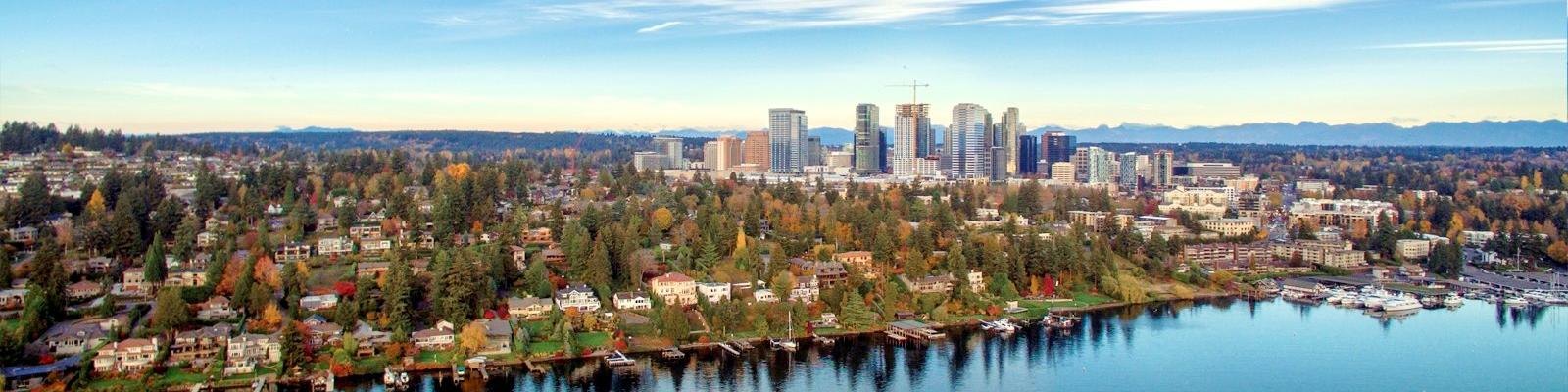
Taiwan-based eNeural Technologies has chosen Bellevue for its North American headquarters, bringing a $3.5 million investment and plans for about 30 jobs over the next three years.
More than 20 of those positions will be artificial intelligence engineering roles, according to Business Facilities Magazine. The company develops lightweight AI solutions that run directly on edge devices, serving customers in logistics, transportation, smart city and enterprise technology.
The hire count is modest for now. But eNeural envisions expanding its Bellevue office into an edge AI research and development center that could support more than 500 employees over the next decade, according to Business Facilities Magazine.
Prof. Jiun-In Guo, founder and chairman of eNeural Technologies, said the Greater Seattle region's AI talent pool, proximity to enterprise customers and access to the technology ecosystem drove the decision.
The Washington State Department of Commerce and local economic development partners supported the company's move, Guo said.
eNeural participated in Greater Seattle Partners' SelectUSA Seattle Spinoff program in 2025, where it connected with the region's AI industry.
Shannon Braddock, president and CEO of Greater Seattle Partners, said the program helped convert that introduction into a long-term investment in Washington state.
The announcement adds to a decade of foreign direct investment in the Greater Seattle region.
Between 2015 and 2025, the area attracted 231 projects, $6.21 billion in capital spending and more than 15,400 jobs, according to Business Facilities Magazine.
T-Mobile completes first AI-RAN call in Bellevue
Separately, T-Mobile completed what it and its partners call the world's first AI-RAN call on a live commercial cell site. The call took place in Bellevue on Saturday, Oct. 17, as first reported by Fierce Network.
AI-RAN, or artificial intelligence radio access network, uses GPU-based computing to run wireless network functions in software rather than on traditional purpose-built hardware.
T-Mobile partnered with Nokia and Nvidia on the test, which used Nokia Massive MIMO radio, Nokia 5G anyRAN software and server infrastructure built on the Nvidia Aerial RAN Computer platform.
The call ran on T-Mobile's live production network and connected to a commercial 5G core with commercial devices, according to a Nokia blog post.
Nvidia CEO Jensen Huang highlighted the milestone at the company's GTC Berlin event on Oct. 21, according to Fierce Network.
T-Mobile Chief Network Officer Ankur Kapoor said the company is exploring a GPU-based AI-RAN architecture with Nokia that combines wireless processing and AI workloads on a flexible computing platform.
He called the Bellevue call "an important step toward the next generation of AI-powered wireless networks."
Nokia said the next phase of field trials will test additional spectrum bands and the ability to run AI workloads alongside wireless network functions on shared infrastructure.