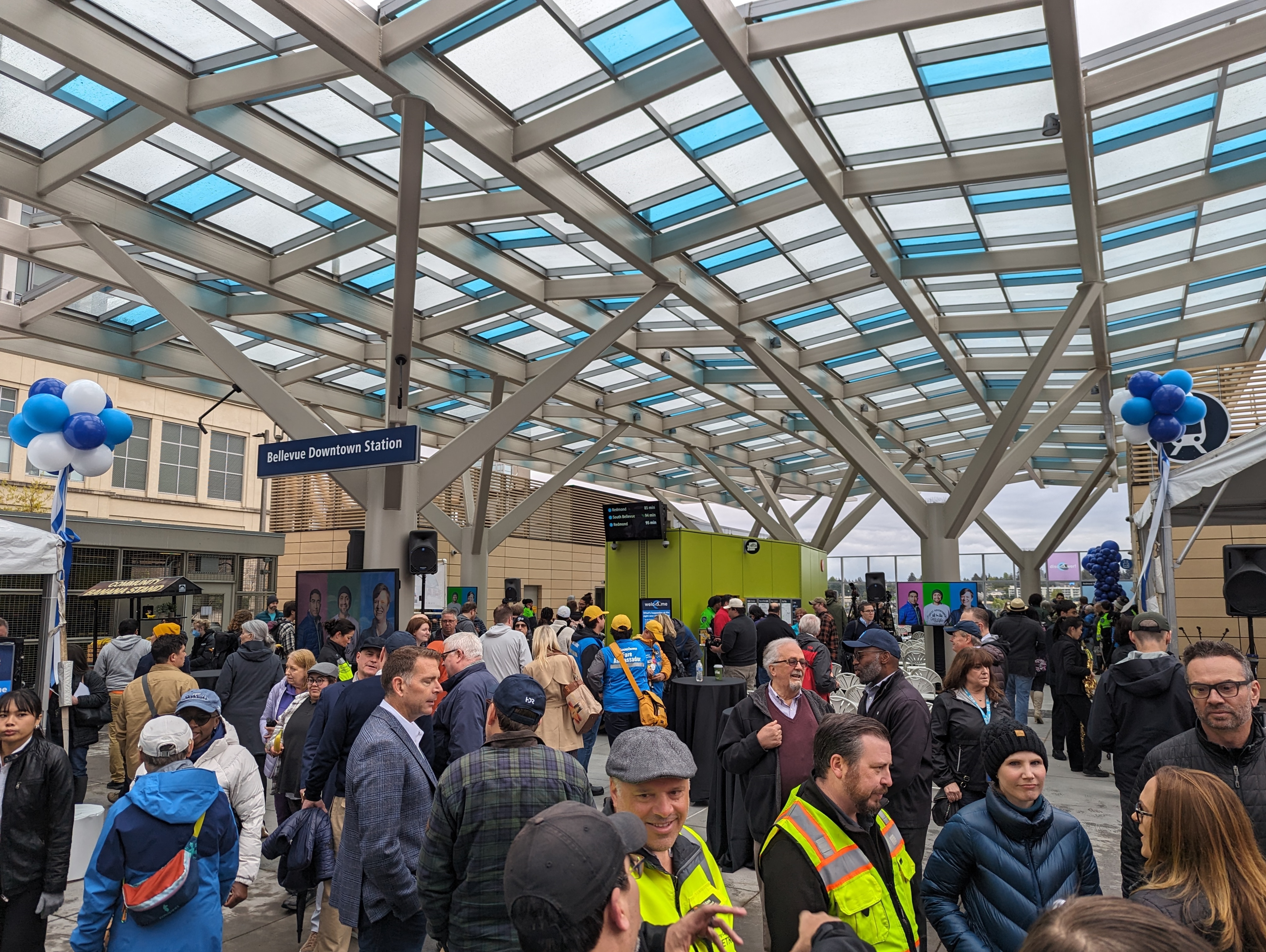
Bellevue Downtown station will be one of 14 light rail stops to get fare gates under an $87 million Sound Transit pilot program approved Aug. 28.
The Sound Transit Board of Directors voted to spend $6 million on design and planning for the gates, KUOW reported. The agency projects the gates could recover between $32.8 million and $82.7 million per year in net fare revenue. The full construction cost will require a separate board vote after the design phase wraps up.
Sound Transit estimates about 37% of riders are not paying, based on automatic counters on trains compared to fares collected. That figure does not account for youth who ride free under state law. Adjusting for them raises compliance closer to 70%, and the agency's fare ambassador program measured 85% compliance in 2025. The gap between those numbers has led some transit advocates to argue the agency is overestimating fare evasion.
The agency's financial model assumes gates will push fare compliance to 95% at gated stations, a target staff said is below the 98% that peer agencies have reported.
Balducci pushes for benchmarks
King County Councilmember Claudia Balducci, who represents the Bellevue area on the Sound Transit board, has pushed the agency for clear performance benchmarks before the program advances. At the board's Rider Experience Committee meeting on Aug. 7, Balducci said she wanted measurable goals and baseline compliance data before final approval, according to The Urbanist.
She said the program should not be "a thing that we're doing because it looks good and makes people feel good that we're doing something, but instead we actually have the goals that we're trying to achieve, and we know whether we're achieving them."
In a separate appearance covered by MyNorthwest, Balducci called fares "a huge part of our funding" and said there is value in everyone contributing to the system.
The financial debate
Not everyone is convinced the numbers add up. KIRO Newsradio host John Curley argued on his Sept. 6 show that Sound Transit currently collects about $60 million in fares from roughly 60% of paying riders. If every rider paid, the theoretical maximum would be about $98 million, leaving $38 million uncollected. Curley said the agency's projection of up to $82 million in annual recovery does not square with that ceiling.
Curley also pointed to San Francisco's BART system, which he said pursued a similar $90 million gate project with a two-to-three-year payback promise but has recovered only about $10 million per year. Curley's BART figures have not been independently verified.
Sound Transit spokeswoman Rachelle Cunningham told KING 5 that earlier studies found gates were cost-prohibitive when the system was smaller. "So now that the system is grown and we looked at it again, it does make sense," Cunningham said.
The Link light rail network now covers more than 60 miles and 50 stations, and daily ridership reached 160,000 even before the FIFA World Cup, according to The Urbanist.
Equity concerns and next steps
King County Executive Girmay Zahilay raised equity concerns at the Aug. 28 board meeting about potentially making it harder for low-income residents to access light rail. About 91,000 people are enrolled in reduced-fare programs such as ORCA LIFT.
Dow Constantine said at the board meeting that staff had heard the emphasis on an equitable engagement strategy and would keep the board updated on progress.
The agency plans to present a fare gate evaluation framework, including goals and metrics, to the board by the end of 2027. Installation could begin in 2029 or 2030, with the pilot running through 2034. The board must still approve the full construction budget in a separate vote.