A legally binding agreement barring Microsoft from using student data to train AI models takes effect Nov. 1, carrying potential implications for Bellevue School District 405 (BSD) and its roughly 20,300 students.
Microsoft and the American Federation of Teachers (AFT) announced the agreement on Monday, Sept. 14. It bans the company from using student data for AI training, advertising or product development across all of its school contracts. The agreement also prohibits AI features that foster emotional dependency in students and requires third-party audits, MyNorthwest reported.
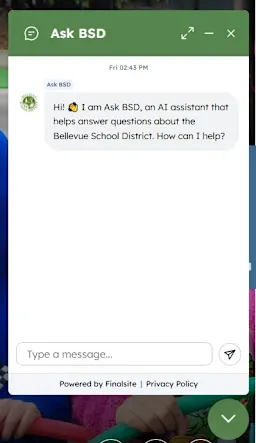
The deal matters locally because BSD runs on Microsoft infrastructure. Staff portals use Microsoft SharePoint and Microsoft Online, according to the district's Technology Services page. BSD is also testing an AI chatbot called "Ask AI" on its website, with plans to expand it to all 30 school sites in September, according to a district announcement. That chatbot is funded through the Technology and Capital Projects Levy.
Under the agreement's terms, "Covered Data" includes student names, grades, disciplinary records, prompts typed into AI tools, AI-generated responses, behavioral patterns, device identifiers and metadata. Microsoft cannot use any of it to train, fine-tune or benchmark AI models except under a narrow safety exception.
The agreement goes further. It bans biometric data collection of any kind, including facial recognition, voice prints and gaze tracking. Automated grading without human review, automated disciplinary decisions and automated course-placement decisions are all prohibited.
"This standard sets a high bar for child privacy and AI safety, and we'll extend this agreement to every school district across the country," Microsoft Vice Chair and President Brad Smith said in a statement.
AFT President Randi Weingarten called the agreement the "first of its kind," framing it as an important step toward an industry standard while federal and state AI-in-schools legislation remains absent.
Whether the agreement covers BSD's specific Microsoft products is an open question. The pact applies to tools "primarily designed and marketed" for students and educators. General-purpose software like Microsoft 365 and Teams is excluded unless it qualifies as an educational product. BSD has not said which Microsoft AI tools it uses under contract.
The district is already grappling with AI's role in classrooms. In a Wednesday, Sept. 2 blog post, Superintendent Kelly Aramaki announced a community Educational Technology advisory launching this fall to examine cell phone policies, limits on district laptop use and how to prepare students for AI while guarding against what Aramaki called its "deskilling" effects on writing, research and critical thinking. That blog post was published before the Microsoft-AFT agreement was announced.
Google, the dominant provider of ed-tech in U.S. schools, had not responded to an Associated Press request for comment on whether it would adopt similar protections as of Monday, Sept. 14. Josh Golin, executive director of online safety nonprofit Fairplay, called Google's silence a "huge question."
BSD has not publicly commented on the Microsoft-AFT agreement. Under the agreement's terms, any school district can request that Microsoft meet or exceed the standard in its own contract within 90 days of the Nov. 1 effective date.